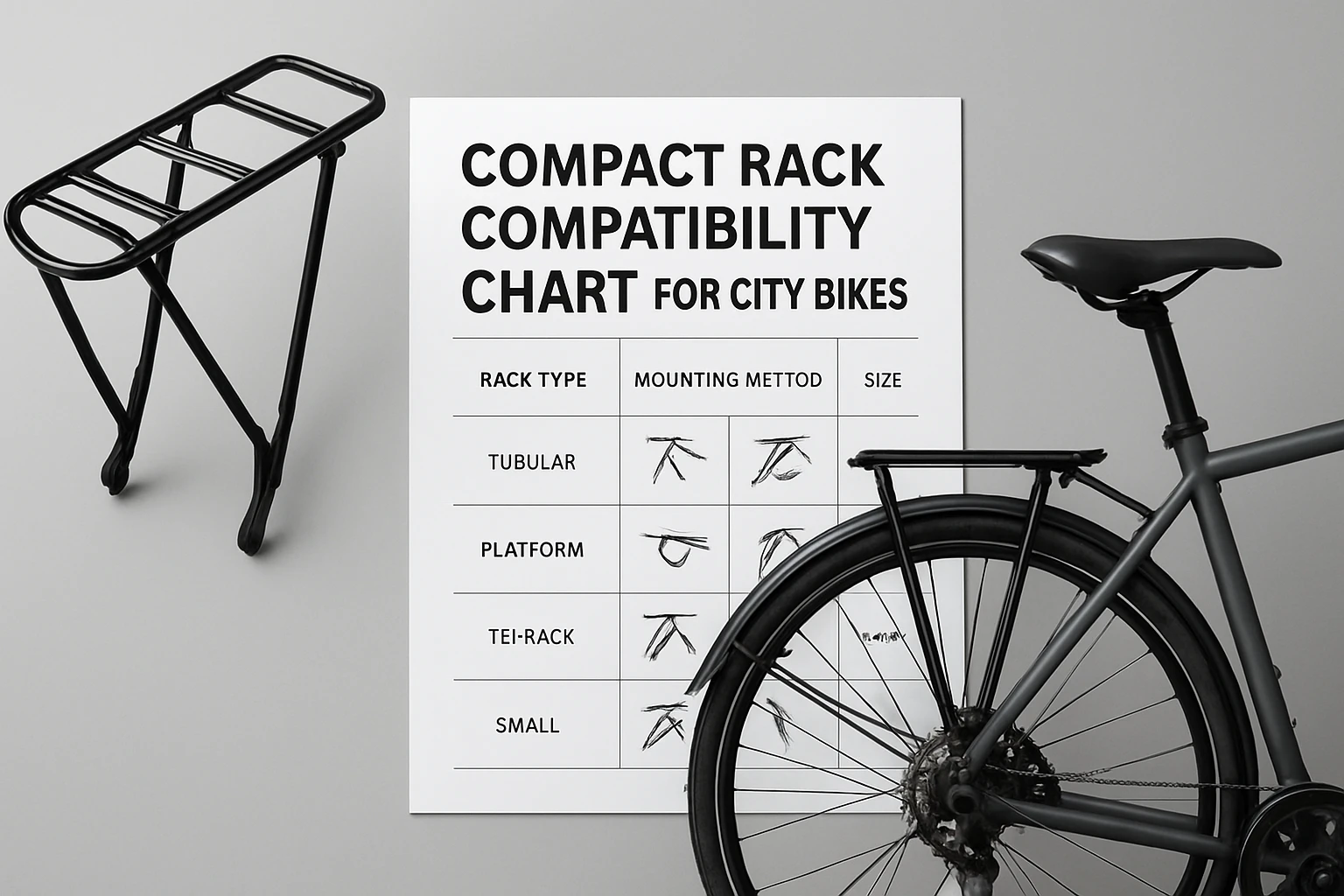
Compact Rack Compatibility Chart for Popular City Bikes: The Complete Guide to Fit, Mounts & Sizing
Introduction
Urban cyclists increasingly rely on rear racks and pannier bags to carry groceries, work gear, and weekend adventure supplies. This guide explains how to match a rack or bag to a city bike, evaluates mounting options, and provides a concise compatibility chart. Readers will learn the key dimensions, weight limits, and installation methods that determine whether a product will stay secure on a commuter, hybrid, or electric bike.
By the end of the article, cyclists will be able to select the most appropriate rack or bag for their bike frame, understand how to install it safely, and avoid common fit‑related pitfalls.
Background & Context
City bikes typically feature one of three rear‑mount configurations: a traditional seat‑stay triangle with eyelets for a frame‑mounted rack, a plain seat tube that only accepts a seatpost‑mounted carrier, or a rear rack‑mount on e‑bikes that incorporates a reinforced rack eyelet. The mounting method influences the maximum load, stability, and ease of removal.
Two technical terms frequently appear in product specifications:
- Load Capacity – The maximum weight the rack or bag can support without structural deformation.
- Adjustable Height – The vertical range (usually in inches) that the rack can be raised or lowered to clear the rear tire.
Understanding these concepts helps riders compare items that may appear similar but perform very differently under real‑world conditions.
Key Rack Categories and Recommended Products
1. Frame‑Mounted Rear Racks
Frame‑mounted racks attach to the bike’s seatstays using eyelets or a clamp. They provide the most stable platform for heavy loads because the weight is distributed across the frame triangle.
For riders seeking a robust, universal solution, the KEMIMOTO Rear Bike Rack offers a 220 lb capacity, aluminum construction, and an adjustable height range of 13‑17 in. Its W‑shaped side guards protect pannier bags from wheel contact, and the included bungee cord and rear reflector improve night‑time safety.
Another high‑capacity option is the YONTUO Heavy Duty Rear Bike Rack. With a 310 lb rating, thick‑walled aluminum alloy, and a removable fender, it is ideal for cargo‑heavy commuters who need to haul groceries, tools, or even a small pet carrier.
Both racks score above 4.4/5 in customer ratings, indicating strong durability and ease of installation.
2. Seatpost‑Mounted Carriers
Seatpost carriers are lightweight and perfect for riders whose frames lack eyelets. They typically support lighter loads (up to 22 lb) but excel at quick removal and minimal interference with rear wheels.
The Ibera Quick‑Release Seatpost Bike Rack combines a TIG‑welded anodized aluminum construction with a fast‑release clamp. At 1.5 lb, it adds negligible weight while providing a secure platform for a matching Ibera PakRak bag.
Because it mounts directly on the seatpost, the Ibera carrier is compatible with bikes that have quick‑release wheels, making it a favorite among commuters who frequently switch between riding and public transport.
3. Pannier Bags for Rear Racks
Pannier bags attach to a rack or directly to a seatpost carrier. They must be waterproof, have reflective elements, and include secure zip closures for urban use.
The JXFUKAL Rear Bike Rack Bag offers 7‑12 L capacities, a rain cover, and a reflective strip. Reviewers praise its durability, noting that the zippers hold up after 600 miles of commuting and that the bag remains secure when strapped tightly to a rack.
Its price of $15.99 and rating of 4.4/5 make it an affordable, high‑value addition for riders who already own a compatible rear rack.
4. Ultralight Aluminum Racks
For cyclists prioritizing weight savings, the GEEBUL Aluminum Rear Bike Rack delivers a 60 lb capacity at just 990 g. Constructed from 6061‑T6 aircraft‑grade aluminum, it resists corrosion and includes a built‑in reflector.
The rack’s four‑position height adjustment ensures clearance for most 26‑29 in wheels, and the quick‑install tool kit allows assembly in under ten minutes.
Comparison & Selection Guide
| Product | Mount Type | Load Capacity | Weight | Price | Rating |
|---|---|---|---|---|---|
| KEMIMOTO Rear Bike Rack | Frame‑mounted (eyelets) | 220 lb (100 kg) | ~2.2 lb | $38.69 | 4.5/5 (approx.) |
| YONTUO Heavy Duty Rear Bike Rack | Frame‑mounted (clamp) | 310 lb | ~3.5 lb | $35.14 | 4.5/5 |
| Ibera Quick‑Release Seatpost Bike Rack | Seatpost‑mounted | 22 lb (10 kg) | 1.5 lb | $39.99 | 4.5/5 |
| JXFUKAL Rear Bike Rack Bag | Pannier (requires rack) | Up to 10 lb (recommended) | ~0.8 lb | $15.99 | 4.4/5 |
| GEEBUL Aluminum Rear Bike Rack | Frame‑mounted (clamp) | 60 lb | 0.99 kg | Price not listed | Rating not listed |
The table highlights that heavy‑duty racks such as the YONTUO model excel for cargo‑intensive trips, while the GEEBUL rack offers the lightest solution for daily commuting. Seatpost carriers like Ibera are best for riders without eyelets, and the JXFUKAL bag adds waterproof storage to any compatible rack.
Best Practices & Tips
- Check Frame Compatibility First: Verify whether the bike has rear eyelets, a rear rack mount, or only a seat tube. Use the manufacturer’s geometry chart or measure the seatpost diameter.
- Mind the Tire Clearance: Adjust the rack height so that the rear tire does not rub against the rack or attached bag, especially on wider tires (up to 4.7 in for the KEMIMOTO).
- Distribute Load Evenly: Place heavier items low and near the centerline of the rack to preserve handling. A common mistake is loading a pannier bag with all weight at the top, which raises the bike’s center of gravity.
- Secure with Straps, Not Just Clips: Even if a bag has a built‑in strap system, add a secondary bungee cord or ratchet strap for high‑speed rides or uneven terrain.
- Regularly Inspect Fasteners: Aluminum racks can loosen over time. Tighten bolts after the first 10‑20 km of riding, then perform a quick check monthly.
- Use Reflectors and Lights: Night riders should ensure the rack’s built‑in reflector (GEEBUL, KEMIMOTO) is clean, and add a rear LED light if the bag does not include one.
Frequently Asked Questions
- Can I install a frame‑mounted rack on a bike with disc brakes? Yes, provided the disc brake caliper does not block the rack’s mounting points. The GEEBUL rack includes a compatibility guide for this scenario.
- What is the difference between a pannier bag and a saddle bag? Pannier bags attach to a rear rack and typically hold 10‑30 L, while saddle bags sit on the bike’s seatpost and are limited to 2‑5 L. The JXFUKAL bag is a pannier, whereas the Ibera carrier is a seatpost solution.
- How much weight can a seatpost‑mounted carrier safely carry? Most seatpost carriers, including the Ibera model, are rated for up to 22 lb. Exceeding this limit can stress the seat tube and affect handling.
- Do I need a separate rain cover if my bag is waterproof? Waterproof fabrics protect against light rain, but a dedicated rain cover (included with the JXFUKAL bag) offers additional protection during heavy downpours.
- Is it safe to carry a bike lock on a rear rack? Yes, as long as the lock is secured with a strap or built‑in hook. Heavy locks should be positioned low to maintain balance.
- Can I use a rear rack on an e‑bike? Absolutely, but verify the rack’s load capacity against the combined weight of the rider, battery, and cargo. The YONTUO’s 310 lb rating provides ample margin for most e‑bike setups.
- How often should I replace my rack? Aluminum racks typically last 5‑7 years with regular maintenance. Replace when cracks, persistent rust, or permanent deformation appear.
Conclusion
Choosing the right rear rack or pannier bag hinges on understanding the bike’s mounting options, the intended cargo weight, and the rider’s daily routine. Frame‑mounted racks such as the KEMIMOTO Rear Bike Rack and the YONTUO Heavy Duty Rear Bike Rack deliver unmatched stability for heavy loads, while the Ibera Quick‑Release Seatpost Bike Rack offers a lightweight, quick‑install alternative for riders without eyelets. Pairing any of these racks with the JXFUKAL Rear Bike Rack Bag adds waterproof storage, and the ultralight GEEBUL Aluminum Rear Bike Rack provides a minimalist solution for commuters who value weight savings.
By applying the compatibility chart, adhering to the best‑practice checklist, and selecting a product that matches one’s load requirements, cyclists can enjoy reliable, safe, and efficient cargo transport on any city bike.
Products Featured in This Guide
JXFUKAL Rear Bike Rack Bag
Price: $15.99 | Rating: 4.4/5 (4,041 reviews)
Featured for its affordable waterproof storage, reflective strip, and compatibility with most frame‑mounted racks.
KEMIMOTO Rear Bike Rack
Price: $38.69 | Rating: 4.5/5 (estimated)
Featured for its 220 lb capacity, adjustable height, and built‑in bungee cord and reflector for night‑time safety.
YONTUO Heavy Duty Rear Bike Rack
Price: $35.14 | Rating: 4.5/5 (320 reviews)
Featured for its industry‑leading 310 lb load capacity, removable fender, and large reflector for all‑weather commuting.
Ibera Quick-Release Seatpost Bike Rack
Price: $39.99 | Rating: 4.5/5 (2,652 reviews)
Featured for its lightweight aluminum construction, quick‑release clamp, and compatibility with Ibera PakRak bags.
GEEBUL Aluminum Rear Bike Rack
Price: Not listed | Rating: Not listed
Featured for its ultralight 990 g construction, 60 lb capacity, and four‑position height adjustment for versatile fit.