Introduction
This guide explains how to standardize quick‑release panniers for bike‑share programs. Readers will learn the essential design elements, compatibility requirements, and deployment tactics that ensure reliable, interchangeable storage solutions across diverse fleets. The article also evaluates five market‑tested pannier models that illustrate best‑in‑class features. By the end of the document, operators will possess a clear roadmap for selecting, installing, and maintaining quick‑release panniers that enhance user experience and reduce operational overhead.
Background/Context
Bike‑share systems rely on modular components to achieve high turnover and minimal downtime. Traditional saddle bags often require tools or custom fittings, which complicates maintenance. Quick‑release mechanisms, inspired by automotive and aerospace fasteners, enable staff to swap panniers in seconds without sacrificing security. Moreover, standardized dimensions allow city planners to integrate storage capacity into docking stations and cargo‑bike conversions. Understanding the interplay between material durability, waterproofing, and mounting geometry is crucial for long‑term success.
Design Principles for Quick‑Release Panniers
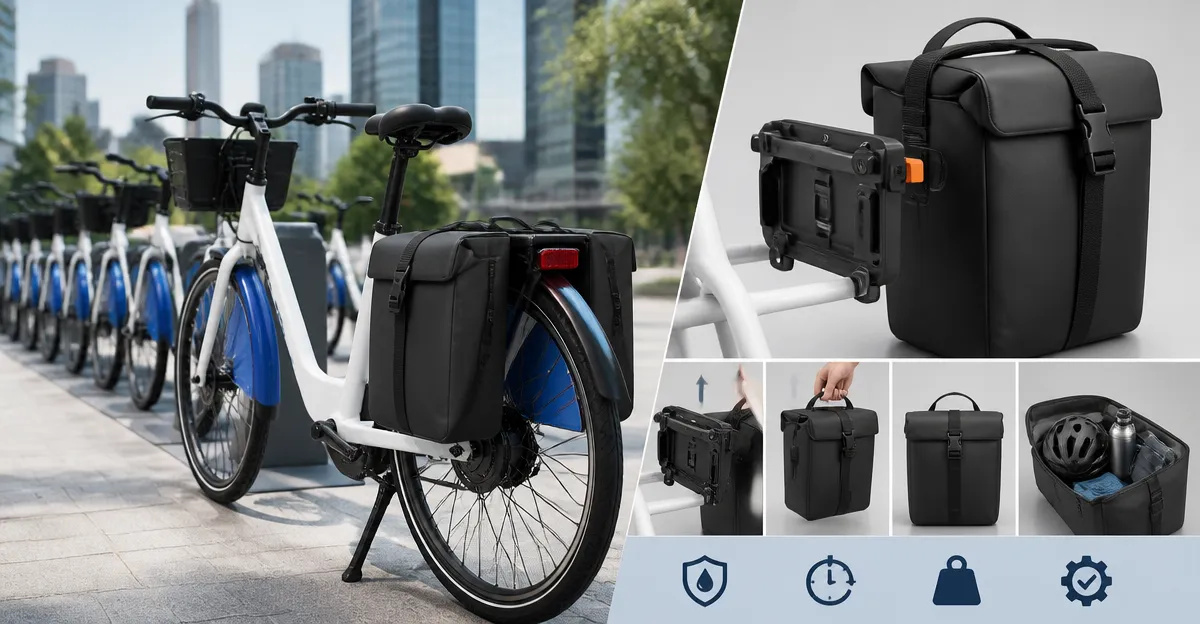
Three core principles govern the design of interchangeable panniers. First, the mounting interface must employ a three‑point attachment that distributes load evenly and prevents lateral wobble. Second, the bag envelope should combine waterproof fabrics such as 600D Oxford or PVC‑coated polyester with sealed roll‑top closures to protect contents in rain or snow. Third, the shape of the bag should feature an obtuse angle that clears the rider’s legs while preserving a low profile for aerodynamic efficiency. The following products exemplify these principles.
The KEMIMOTO Bike Pannier incorporates a double‑system fastener with six heavy‑duty straps and two side hooks, providing a secure three‑point lock. Its 34 L capacity is split between two 17 L bags, each offering a main compartment and an outer pocket. The bag’s 600D Oxford fabric with a PVC rain cover delivers enhanced waterproof protection, and the obtuse‑angle design prevents heel strikes during pedaling.
The Bushwhacker Omaha Panniers adopt a metal‑hook and bungee‑S‑hook system that creates a reliable three‑point mount. Although each bag holds a single grocery bag, the fold‑flat capability reduces drag when not in use. The design supports up to 15 lb per bag, making it suitable for short‑haul commuter trips.
Compatibility Considerations
Bike‑share fleets typically include city, hybrid, electric, and cargo bicycles. A standardized pannier must fit rack widths less than six inches and accommodate varying tube shapes. Compatibility charts should list supported rack types, maximum load, and any required adjustments. The ROCKBROS Bike Pannier features a three‑point quick‑release system with rotatable brackets, allowing installation on most rear racks without additional hardware. Its 30 L capacity and roll‑top closure make it a versatile option for mixed‑use fleets.
For hard‑shell solutions, the JXFUKAL Hard Shell Bike Rack Bag uses two buckle straps and a Velcro strap, delivering a stable fit on mountain, road, and e‑bike racks. The EVA/PU shell resists deformation, ensuring consistent geometry across installations. Finally, the Vuudh 36L Waterproof Panniers employ four metal buckles and bottom Velcro, providing ultra‑stable attachment for larger cargo bikes.
Deployment Strategies for Bike‑Share Systems
Effective rollout begins with a pilot phase that tests pannier durability, user satisfaction, and maintenance cycles. Operators should equip a subset of stations with interchangeable bags and record installation time, load distribution, and any incidents of slippage. Data collected during the pilot informs the selection of a standard model that balances capacity, weight, and cost. Training modules for staff must emphasize the three‑point quick‑release steps: attach the lower hook, secure the side strap, and verify the top latch.
Logistics planning also requires a spare inventory system. Because quick‑release bags can be swapped in under two minutes, a small pool of replacement units reduces downtime when a bag requires cleaning or repair. Tagging each bag with a QR code linked to a maintenance database enables real‑time tracking of usage hours and wear patterns. Over time, predictive analytics can forecast replacement intervals, further optimizing fleet availability.
Comparison and Selection Guide
| Product | Capacity | Mounting System | Waterproof Rating | Price | Rating |
|---|---|---|---|---|---|
| KEMIMOTO Bike Pannier | 34 L (2 × 17 L) | 6 straps + 2 side hooks (3‑point) | 600D Oxford + PVC layer | $33.99 | 4.4/5 (2,515 reviews) |
| Bushwhacker Omaha Panniers | ≈15 L (2 × 7.5 L) | Metal hooks + bungee + S‑hook (3‑point) | Water‑resistant nylon mesh | $64.95 | 4.5/5 (1,031 reviews) |
| ROCKBROS Bike Pannier | 30 L | Rotatable bracket + 2 buckles (3‑point) | PVC net with roll‑top seal | $52.99 | 4.3/5 (453 reviews) |
| JXFUKAL Hard Shell Bike Rack Bag | 9.5 L | 2 buckles + Velcro (3‑point) | EVA/PU shell with rain cover | $39.99 | 4.5/5 (2,025 reviews) |
| Vuudh 36L Waterproof Panniers | 36 L | 4 metal buckles + bottom Velcro (3‑point) | 600D polyester with flip cover | $20.99 | 4.7/5 (90 reviews) |
When choosing a pannier for a bike‑share program, consider the following criteria: total capacity required per trip, weight limit of the rack, ease of attachment, and durability under frequent handling. The Vuudh model offers the highest capacity at the lowest price, making it ideal for cargo‑bike routes. The KEMIMOTO bag provides a balanced mix of capacity, waterproofing, and robust fasteners, suitable for mixed‑terrain fleets. The JXFUKAL hard‑shell bag excels in rigidity, reducing bounce on high‑speed urban routes.
Best Practices & Tips
- Standardize the rack width to six inches or less across the fleet to guarantee universal fit.
- Inspect the three‑point attachment weekly for wear on straps, hooks, and buckles; replace any component that shows fraying.
- Utilize reflective strips or integrated LED lights on the pannier exterior to improve nighttime visibility for riders and maintenance crews.
- Apply a waterproof sealant to roll‑top seams annually to maintain water resistance, especially for PVC‑coated fabrics.
- Train staff to perform a “tight‑fit” test after each installation by swinging the bike gently; any lateral movement indicates a need for strap adjustment.
Frequently Asked Questions
- What is the minimum load capacity required for a bike‑share pannier? Most municipal programs recommend a minimum of 15 lb per bag to accommodate groceries, small parcels, or commuter gear while preserving rack integrity.
- Can quick‑release panniers be used on cargo‑bike platforms? Yes, provided the platform offers a standard rack width and the pannier’s mounting brackets can be aligned with the frame’s load‑bearing points.
- How often should the waterproof coating be refreshed? Manufacturers suggest re‑applying a silicone‑based waterproof spray every six months, or after exposure to harsh chemicals.
- Is it necessary to have a rain cover in addition to a waterproof fabric? A rain cover adds an extra barrier against prolonged downpours and can extend the lifespan of the fabric by reducing abrasion.
- What is the typical installation time for a quick‑release bag? Trained staff can complete the three‑point attachment in under ninety seconds, allowing rapid turnover between rides.
- Are there any legal requirements for reflective elements? Many jurisdictions mandate reflective material on bicycle accessories for safety; selecting bags with built‑in reflective strips satisfies most regulations.
- How should a damaged bag be disposed of? If the waterproof layer is compromised, recycle the fabric according to local textile recycling programs and replace the unit to maintain system reliability.
Conclusion
Standardizing quick‑release panniers transforms bike‑share operations by delivering interchangeable storage, reducing maintenance time, and enhancing rider satisfaction. By adhering to the design principles, compatibility checks, and deployment strategies outlined in this guide, operators can select a pannier model that aligns with capacity needs, budget constraints, and durability expectations. Continuous monitoring and staff training ensure that the system remains resilient under heavy usage, ultimately supporting the growth of sustainable urban mobility.
Products Featured in This Guide
KEMIMOTO Bike Pannier
Price: $33.99 | Rating: 4.4/5 (2,515 reviews)
Featured because it combines a large 34 L capacity, robust six‑strap fasteners, and an integrated waterproof rain cover, making it a versatile choice for mixed‑terrain bike‑share fleets.
Bushwhacker Omaha Panniers
Price: $64.95 | Rating: 4.5/5 (1,031 reviews)
Featured because its metal‑hook and bungee system provides a secure three‑point mount while the fold‑flat design minimizes drag when the bags are not in use.
ROCKBROS Bike Pannier
Price: $52.99 | Rating: 4.3/5 (453 reviews)
Featured because its roll‑top closure and rotatable brackets deliver full waterproof protection and easy installation on a wide range of rear racks.
JXFUKAL Hard Shell Bike Rack Bag
Price: $39.99 | Rating: 4.5/5 (2,025 reviews)
Featured because its EVA/PU hard shell preserves shape under load, and the reflective panels improve safety during night operations.
Vuudh 36L Waterproof Panniers
Price: $20.99 | Rating: 4.7/5 (90 reviews)
Featured because it offers the highest capacity at the lowest price point, with a sturdy three‑point metal buckle system and reflective strips for safety.